
Who I am
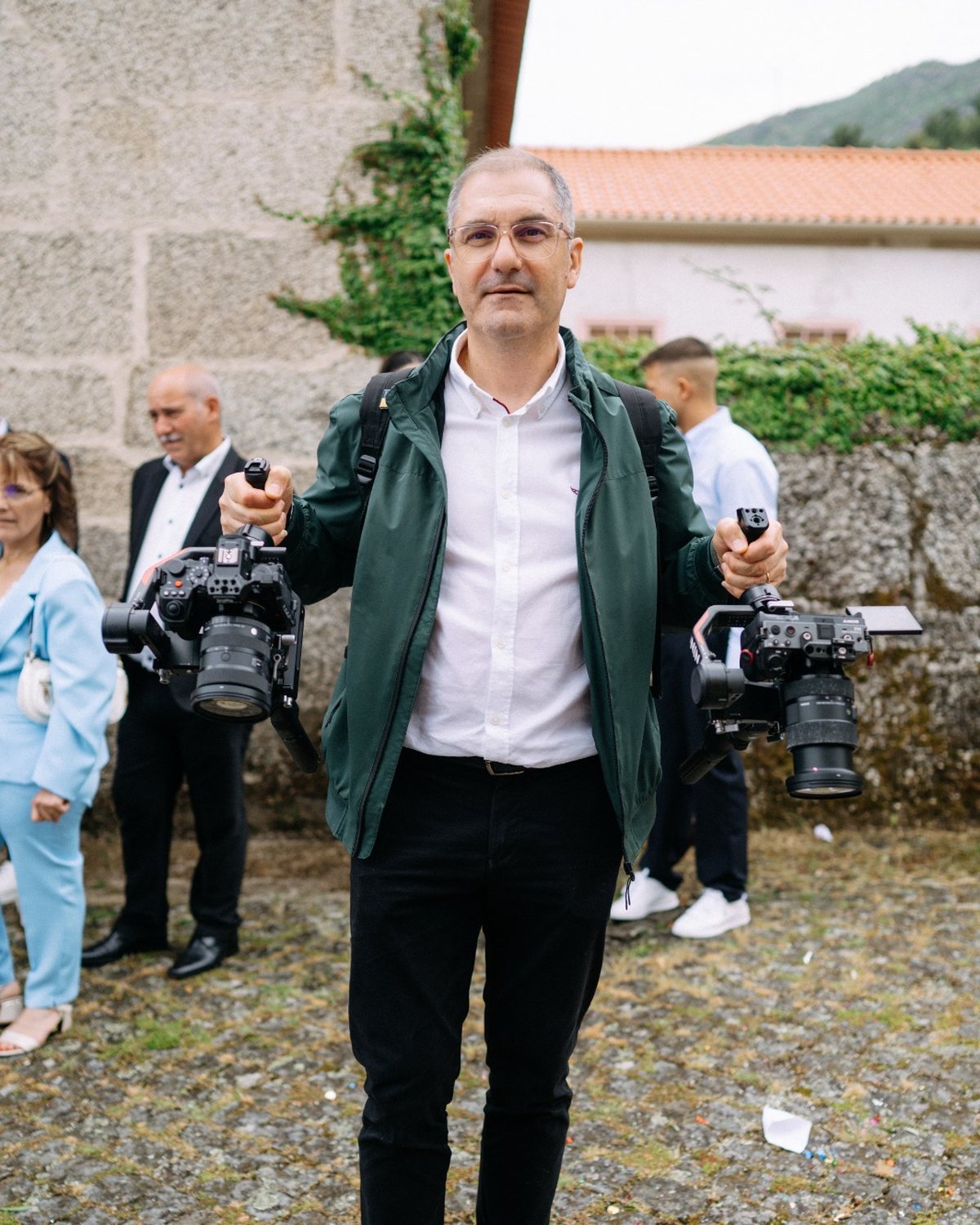
My name is Martinho Arantes. I work out of Galegos Santa Maria, Barcelos, and I film weddings across the Minho and most of Portugal.
I’m a fairly reserved person, which doesn’t sound like much of a selling point until you see what it’s for. I’m not someone who takes over a room. At a party I’m more likely to be leaning against a wall watching than out in the middle. After a while I realised that wasn’t a flaw in the job — it was the job. People behave differently when someone watches them without asking anything of them.
I’ve been filming weddings for more than 8 years and I’ve lost count of the churches in the Minho I’ve stood in. A round number of weddings filmed would look good here, but I never counted — and it has never seemed to me that a number is what makes you trust someone.
Where I come from
I trained in computing — an IT and management degree. I finished it and realised that what actually interested me was somewhere else: video, and above all the way cinema solves things. I spent a long stretch trying to rebuild effects at home, copying shots I had seen, working out why one scene held and the next one did not.
I started filming properly for companies. Promos, corporate work, whatever came along. Then someone asked me to film a wedding, at a quinta in Ponte de Lima.
It was another thing entirely. In a corporate video the story is the one the client wants told, and I am the one building it. At a wedding the story already exists before I arrive — every couple brings their own — and my job is to stay out of its way. The emotion of that day cannot be staged and does not come round again: you either catch it or you lose it.
That is why I stayed.
Outside work, my time belongs to Ana, my wife, and to our children. Family and faith are what steer me, and it does not feel like an accident that I ended up filming exactly this: people committing themselves to one another. I know the weight of the day I am asked to keep.
The way I work today came from somewhere else: from filming alongside photographers. A lot of my weddings come through a photographer’s recommendation or subcontract, and anyone who works that way learns one thing quickly — the space in the middle of the church isn’t only yours. I learned to read where the other person is going to stand, to give up the good angle when it needs giving up, and to solve my problem without creating one next to me. That ended up being my signature.
How I work
I’m on my own at most weddings and that’s how I work best. One more person in the room is always one more person to notice.
When a wedding has the scale for it — a lot of guests, ceremony and party far apart, or a couple who want parallel coverage — I bring a second operator, and I always choose someone who works the same way I do. There’s no point in my being discreet if the person next to me isn’t.
I don’t bring a production crew, I don’t bring an assistant to hold lights, and I don’t set up anything I can’t strike on my own in two minutes. That isn’t about saving money: it’s what lets me be in one place and, three minutes later, in another, without anyone noticing.
I film one wedding a day. Always.
What I work with
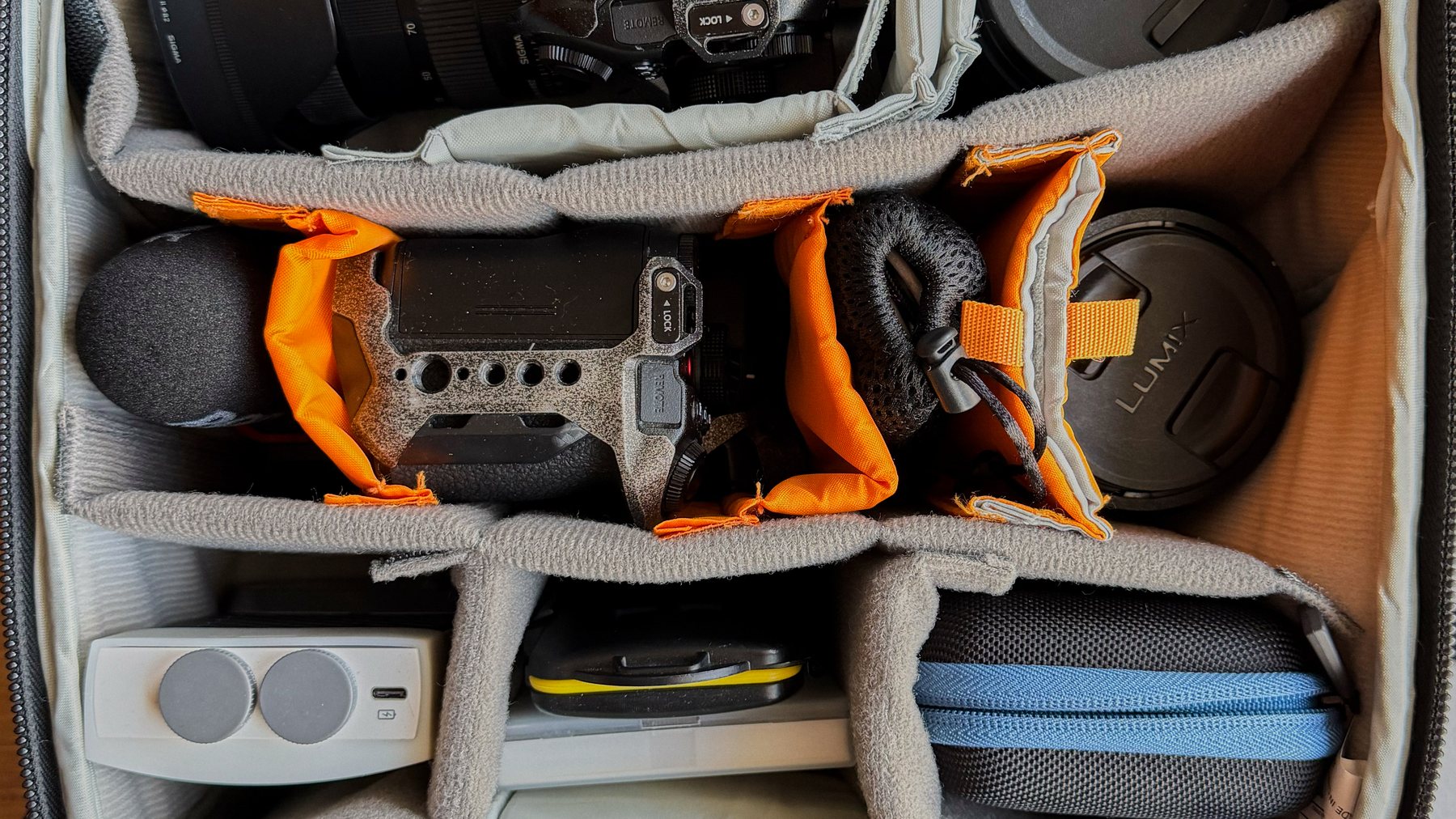
I don’t think a kit list should help you choose a wedding filmmaker, which is why it’s down here and not on the front page. But some people like to know, and that’s fair.
I film with a Panasonic S5 II and a Fujifilm XH2S. The first is the main camera and it handles the worst a wedding can throw at it: church light, late-afternoon light, and no light at all. The second is with me all day, usually with a long lens, and it’s what I shoot most of the getting-ready and the ceremony on — it’s the one that lets me stay far away and still be close.
For lenses I use Panasonic, Tamron, Viltrox and Sigma. I’m not a purist about brands; I choose by what each lens lets me do without having to come closer than I should.
For light I have an Aputure HL 672s and Amaran panels, and I use them as little as possible. A light switched on changes a room and changes the people in it. During getting-ready I rarely turn anything on; at night, if the dance floor is genuinely dark, I put one small light in a corner and leave it there.
For sound I work with Rode microphones and Tascam recorders, and it’s the part of the kit I care about most. They’re what guarantee that the vows, the sermon and the toasts are recorded whole and clean, even when I’m on the other side of the room. It’s also what makes the documentary film possible.
For aerials I use a DJI Mini 4 Pro, and I use it with judgement: at estates with room for it, late in the afternoon, and never over a ceremony. A drone buzzing over the church is the exact opposite of what I promise you.
Where I am
Galegos Santa Maria, Barcelos. Within 100 km of here there’s no travel cost.
I’m very glad to film outside that area, including weddings abroad. I’ve worked with couples who came from elsewhere to marry in Portugal, and I handle everything in English without any trouble — the first email, the calls before the day, and the day itself.